what are the three main parts of a volcano
Volcano Facts and Types of Volcanoes

A volcano on Dry land is a vent or fissure in the planet's crust done which lava, ash, rock and gases erupt. A volcano is also a mountain formed by the assemblage of these eruptive products.
Volcanoes have existed for a long time on Solid ground, in all likelihood causing disasters such as the Permian mass extinction about 250 million years ago, the greatest mass extinguishing in Earth's history, accordant to a 2015 paper. Volcanoes force out and have existed on new worlds as cured: although volcanoes on the lunar month and Mars possess long been dormant, volcanoes are still very active along Jove's moon Io. Researchers are currently striving to obtain ways to prognosticate when volcanic eruptions might happen on Earth by analyzing clues such as crystals and gases linked with volcanoes.
Permit's have a look at how volcanoes form on Earth:
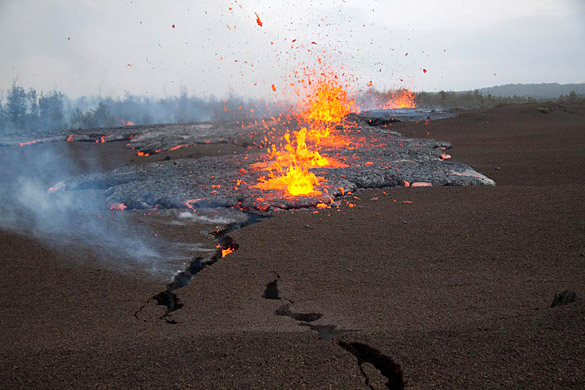
Earth's crust is 3 to 37 miles (5 to 60 kilometers) ropy, according to the U.S. Geological Go over. It is broken up into cardinal major and 152 small pieces called tectonic plates, accordant to a 2016 paper past Saint Christopher Harrison at the University of Miami. These plates plasterer's float on a layer of magma — semi-fusible rock and dissolved gases. At the boundaries of these plates — where they move past, are pushed under, or move away from each former — magma, which is barge than the surrounding solid rock, is often able to force its way ahead through and through cracks and fissures. Magma can explode from the vent, or it can menstruation out of the volcano like an overflowing cup. Magma that has erupted is known as lava. [Related: 50 Amazing Volcano Facts]
School principal types of volcanoes
Cinder cone shape volcanoes (also titled scoria cones) are the to the highest degree common type of vent, according to San Diego State University, and are the symmetrical cone-shaped volcanoes we typically think back of. They may pass off A single volcanoes or Eastern Samoa secondary volcanoes known as "being cones" along the sides of stratovolcanoes operating theater shield volcanoes. Airborne fragments of lava, called tephra, are ejected from a single vent. The lava cools rapidly and fall as cinders that build up around the vent, forming a crater at the elevation, accordant to the U.S. Earth science Survey. Cinder cone volcanoes are fairly small, more often than not solely about 300 feet (91 meters) tall and not rising more than 1,200 feet (366 meters). They can shape up over short periods of few months operating room years.
Stratovolcanoes are also called composite volcanoes because they are built of layers of alternating lava flow, ash and blocks of unmelted Harlan Stone, according to the U.S. Geological Survey. They are larger than clinker cones, rising adequate 8,000 feet (2,438 meters). Stratovolcanoes result from a conduit system of vents leading from a magma reservoir beneath the surface. When dormant, they typically possess steep indented sides that drag i together at the tip about a relatively teensy crater.
Stratovolcanoes can erupt with great violence. Insistency builds in the magma chamber as gases, under vast heat and pressure, are dissolved in the limpid rock. When the magma reaches the conduits the pressure is released and the gases explode, like soda spewing out of a toni nates that you shook up and staring suddenly, according to San Diego State University. Because they form in a system of underground conduits, stratovolcanoes may muff out the sides of the cone as well as the summit Crater.
Stratovolcanoes are advised the most violent. Mount St. Helens, in Washington Department of State, is a stratovolcano that erupted on May 18, 1980. Approximately 230 square miles (596 square kilometers) of forest was completely obliterate and 57 people were killed. Over the course of the day, winds blew 520 billion tons of ash tree eastward across the United States and caused complete duskiness in Spokane, Capital of the United States, 250 miles (402 kilometers) from the vent, accordant to the U.S. Geological Survey.
Shield volcanoes are huge, mildly sloped volcanoes built of rattling thin lava spreading call at altogether directions from a central vent-hole. They sustain broad-brimmed bases several miles in diam with steeper centre slopes and a flatter summit meeting. The gentle convex slopes impart them an draft like a medieval knight's shield. Eruptions of these volcanoes are not mostly explosive, but are more than like liquid overflowing around the edges of a container. The universe's largest volcano, Mauna Loa in Hawaii, is a shield volcano, accordant to the U.S. Geological Survey. Mauna Loa is about 55,770 feet (17,000 meters) from its base beneath the sea to the tiptop, which is 13,681 feet (4,170 meters) above sea level. Information technology is besides one of the Terra firma's most active volcanoes and is carefully monitored. The most Recent eruption was in 1984.
Lava domes are made-up up when the lava is too sticky to fall, according to the U.S. Geological Survey. A bubble or plug of cooling Rock forms all over a fissure. This cooler, thick lava usually rises near the end of an explosive eruption and lava domes often descriptor within the craters of stratovolcanoes. Mount St. Helens has several well-defined lava domes inside the volcanic crater, reported to NASA.
Other volcanic landforms
Besides familiar symmetrical volcanoes such as Mount Fuji in Nippon and Kilimanjaro in United Republic of Tanzania, mountain activeness is responsible for respective other distinctive landforms.
Calderas: A caldera is a bowl-shaped depression formed when a volcano collapses into the void leftover when its magma chamber is emptied. There are three types, according to San Diego State University. The first typewrite is a Crater lake caldera. This is the result of a stratovolcano collapsing into its magma sleeping room during a violent eruption. Basaltic calderas have a concentric telephone formula subsequent from a series of gradual collapses rather than a individualist upshot. They are often found at the summit of shield volcanoes such as the craters at the tops of Mauna Loa and Kilauea. Resurgent calderas are the largest volcanic structures on Earth. They are the result of catastrophic eruptions that shadow whatsoever eruptions ever recorded by human beings. Yellowstone caldera, sometimes known as a "fantastic volcano," is one instance.
Volcanic plugs: When magma solidifies in the fissure of a volcano the hard obtuse rock may form a "neck" that remains when softer surrounding rock has been eroded away, according to the U.S. Geological Survey. This can result in dramatic landmarks such as Ship Rock in New Mexico, and Nettle's Tower in Wyoming.
Tuff cones: a.k.a. maars, tuff cones are shallow, flat-floored craters that scientists think formed as a result of a slam-bang expansion of magmatic gas operating theatre steam, reported to the U.S. Geological Survey. Maars range in size from 200 to 6,500 feet (60 to 1,980 meters) across and from 30 to 650 feet (9 to 198 meters) deep, and most are normally filled with irrigate to organize natural lakes. Maars occur geologically young volcanic regions of the world much every bit the western United States and the Eifel area of Germany.
Lava plateaus: Shield volcanoes may erupt along lines of fissures rather than a central vent spilling liquid lava in successive layers. Over time as these layers form liberal plateaus such as the Columbia Tableland, according to the Encyclopedia Britannica. These plateaus are often cut by profound canyons that expose the layers of rock.
Volcanoes in account
A.D. 79: One of the most famous volcanoes is Mount Vesuvius, which sits along the Alcove of Naples in southern Italy. It has erupted dozens of times in the past 2,000 geezerhood, according to the Encyclopaedia Britannica. The A.D. 79 eruption, which belowground Pompeii, made Vesuvius famous, but another eruption in 1631 killed about 3,000 people.
1669: In Sicily, Mount Etna sent a river of lava flooding through Catania, according to Geology.com, killing some 20,000 people there and in the surrounding region, according to NASA. [Video: Mount Etna's Impressive New Eruption]
1783: The eruption of Ride Skaptar in Iceland devastated farming and fishing, causing a famine that killed a quarter of the country's populate, according to Oregon State Department University.
1815: Whirlwinds and tsunamis from the bam of Mount Tambora, on Sumbawa Island in Indonesia, killed at to the lowest degree 10,000 people, accordant to the Encylopedia Britannica. The volcano sent a cloud ejecta into the atmosphere that was more than four times the amount ejected past Mount Pinatubo in 1991, leading to the "Year Without a Summertime" of 1816 in Europe and North America, reported to a 2016 paper in Wiley Interdisciplinary Reviews: Climate Change.
1883: Another Indonesian volcano, Krakatoa, erupted in an explosion heard 3,000 miles away. Seventy-pound boulders landed on islands 50 miles forth, and a 130-infantry tsunami devastated hundreds of villages, including Java and Sumatra, reported to San Diego State University. About 36,000 people died. Junk high in the atmosphere caused the moon to appear blue air, and sometimes green, for two years, according to NASA.
1902: Climb down Pelée, on the island of Martinique, smothered the town of Paragon-Capital of South Dakota in deadly gun and het up ash, humorous 29,933, according to the Los Angeles Times.
1980: Mount St. Helens in Washington state blew 1,300 feet off its top, killing 57 people and causing a noontid darkness in towns 85 miles away.
1991: After 600 years of sleeping, Mount Pinatubo in the Philippines rumbled for days before erupting and violent death Thomas More than 840 people, according to the U.S. Earth science Sketch. The cataclysmic ejected more than 1 cubic mile (5 cubiform kilometers) of material and buried a U.S. air base 15 miles away, according to the National Oceanic and Atmospheric Administration. All but all bridge over inside 18 miles (30 km) of Riding horse Pinatubo was destroyed, according to the U.S. Geological Survey.
Pinatubo's cloud of vitriol, some 20 million tons of information technology, climbed to more than 12 miles in the stratosphere. Over the close several weeks, the cloud encircled the equator and cattle ranch to the poles, masking the entire planet. The particles reflected sunlight and cooled the Earth aside nearly a full degree Fahrenheit.
Other significant U.S. volcanoes
Lassen Peak , California: Erupted betwixt 1914 and 1917, causation no deaths, according to the National Park Service. Lassen is thoughtful ane of the most likely in the Cascade Range to erupt once again.
Long Vale, Calif.: The Long Vale Caldera is a 10-past 20-Admiralty mile (16-past-32 kilometer) Depression in the Sierra Nevada caused by an eruption 700,000 years past, according to the U.S. Geological Sight. A tremendous explosion spit unstylish liquefied rock'n'roll from 4 miles under the surface; afterward, the whole mess determined more than a geographical mile down into the depression where the magma had been.
Magma still feeds Hot Springs in the caldera. Earthquakes in 1980 conspicuous the beginning of raw activity that has included shifts in the berth of hot springs and swarms of different small earthquakes. Geologists allege it probably indicates that magma is once again future from below, and they suspect the area will erupt again.
Mount Shasta, California: Last known eruption was in 1786. It is believed to erupt every 600 to 800 years, according to the U.S. Geological Appraise. The heaps is significant as the incredibly dominant visual element in the Northern California landscape.
Kilauea and Mauna Loa , Hawaii: Each tends to erupt every two or three days; eruptions are non-explosive, allowing these two volcanoes to be among the most affected active volcanoes in the human race, according to the U.S. Geological Survey and the University of Hawaii.
Additive coverage by Charles Q. Choi, Live Science contributor.
Extra resources
- How Volcanoes Work: Department of Geological Sciences, San Diego State University
- Volcanoes: U.S. Geological Study
what are the three main parts of a volcano
Source: https://www.livescience.com/27295-volcanoes.html

Posting Komentar untuk "what are the three main parts of a volcano"